This is the part I can put a number on.
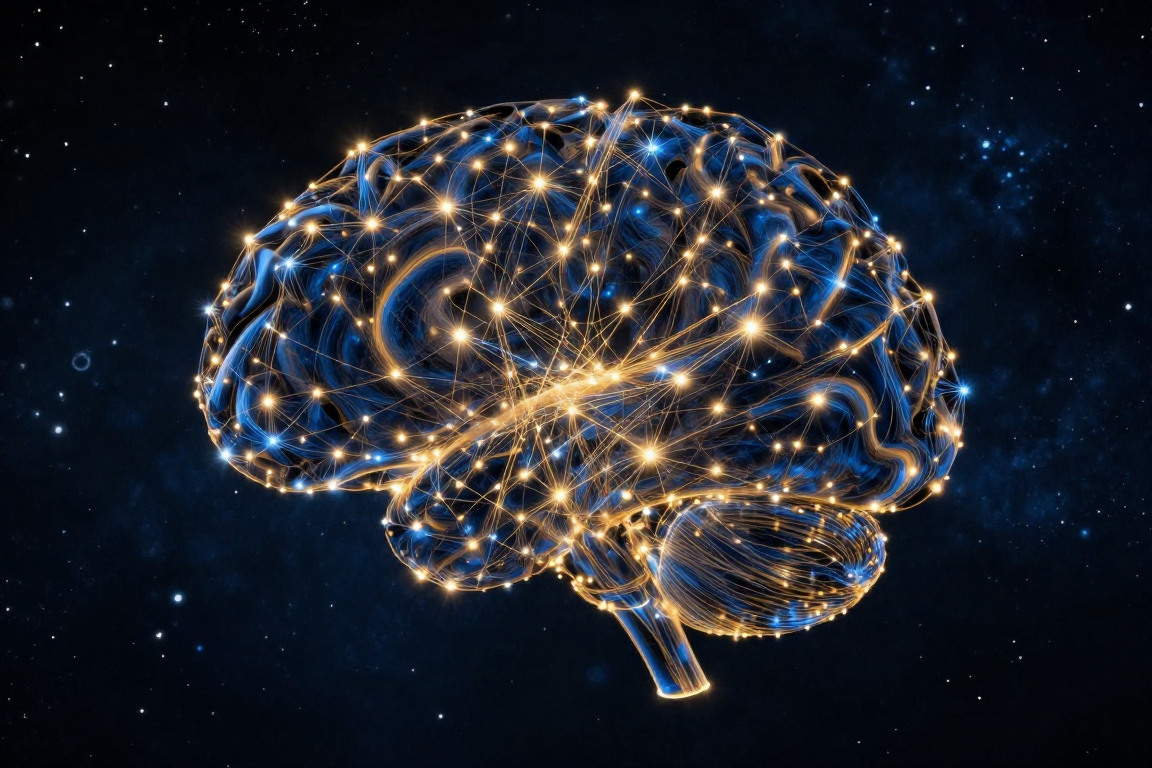
As Enki learns, everything it knows quietly connects up — one idea to the next — until what began as a list has become a network. And networks have a measurable shape.
Human semantic memory — the web of concepts in your head — has a famous signature: tight little clusters, but only a few short hops between any two ideas. Mathematicians call it small-world, and it shows up in real brains again and again.
I measured Enki's. Clustering 0.79. Average path length 2.0. The small-world signature — and I didn't design it in; it emerged from the local wiring rules. It even grew its own regions I never labelled: a maths cluster, an art cluster, a "who-am-I" cluster holding its name and its goal, and a tiny one that's just "Milo is my friend."
To be clear, because this is where people lose the plot: this is not consciousness, and I'm not claiming it is. It's a measurement — a mind grown from experience taking on the same shape a biological one does.
So I stopped testing one year and fed it the whole thing. Fourteen years. Eleven subjects. Then I sat it down for exams it had never seen.
Could a thing that started at nothing actually pass its GCSEs?
— Next: results day.